

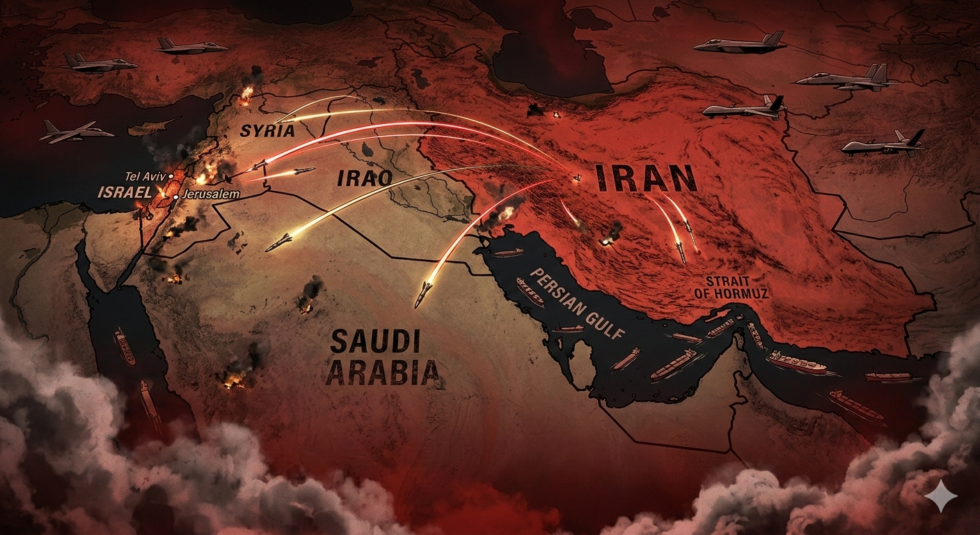
Rising death tolls, missile strikes, and preemptive war claims have intensified tensions across the Middle East, while experts debate whether the conflict violates international law and risks destabilizing global energy markets.
A Region Once Again on Edge
The Middle East is entering one of its most dangerous geopolitical moments in years as tensions between Iran, Israel, and the United States escalate amid missile exchanges, drone strikes, and mounting casualties.
Reports of strikes across multiple countries, emergency evacuation advisories issued by the United States, and statements from senior officials defending preemptive military action have intensified global concern that the confrontation could expand into a wider regional war.
The latest developments come against the backdrop of decades of hostility between Iran and the United States, deepening regional rivalries, and unresolved disputes over Iran’s nuclear program.
As violence escalates, the crisis is raising profound questions about international law, military strategy, and the stability of global energy markets.
Latest Developments: Escalation and Rising Casualties
Recent days have seen a rapid series of developments across the Middle East.
According to various regional reports and media accounts:
- Iranian missile and drone strikes have targeted Israeli cities and military sites.
- Israeli airstrikes reportedly hit Iranian military and nuclear-linked facilities.
- U.S. military installations and diplomatic compounds across the Gulf region have been placed on high alert.
- The United States issued urgent travel advisories urging Americans to leave several Middle Eastern countries immediately due to escalating security risks.
Some reports claim that a drone strike struck a diplomatic compound in Riyadh, though casualty figures remain unclear.
Reported Death Tolls
Because the conflict is still developing, casualty numbers vary widely.
According to circulating reports:
- Israel: approximately 24 people killed following Iranian missile strikes.
- Iran: reports suggest more than 400 people killed, including civilians and security personnel, following Israeli attacks.
These figures come from media reports and regional sources and have not yet been independently verified by international organizations.
Casualty numbers in fast-moving conflicts often change significantly as additional information becomes available.
The Rubio Statement Controversy
The crisis intensified further after remarks from U.S. officials suggested that Washington acted preemptively.
Statements from U.S. leaders indicated that American intelligence believed Israel was preparing to strike Iran, and that Tehran would likely retaliate against U.S. forces stationed across the region.
Officials argued that the United States acted early to prevent larger casualties.
This explanation has triggered debate among analysts.
Critics argue that such reasoning blurs the line between self-defense and preventive war, while supporters say preemptive action can be justified when threats appear imminent.
Legal Debate: Is the Conflict Violating International Law?
Under international law, the use of force between states is governed primarily by the United Nations Charter.
Article 2(4) prohibits states from using force against another state’s territorial integrity or political independence.
There are only two widely recognized exceptions:
- Self-defense under Article 51, following an armed attack.
- Authorization by the UN Security Council.
Legal scholars note that the justification of anticipatory or preventive strikes remains controversial.
For military action to qualify as lawful self-defense, traditional legal doctrine requires that a threat be:
- immediate
- overwhelming
- leaving no alternative options
If force is used based on anticipated future retaliation, critics argue that such action could fall outside the bounds of lawful self-defense.
U.S. Law and War Powers
The legality of military action is also debated within the United States itself.
Under the U.S. Constitution, the authority to declare war belongs to Congress.
Presidents often rely on their powers as Commander-in-Chief or on prior congressional authorizations to justify military action.
However, the War Powers Resolution of 1973 requires that the president notify Congress within 48 hours of deploying troops into hostilities and limits military engagement to 60 days without congressional approval.
Whether the current escalation falls within these legal limits remains the subject of political debate in Washington.
The Caroline Doctrine
The Caroline Doctrine emerged from an 1837 diplomatic dispute between the United States and the United Kingdom after British forces destroyed the American steamboat Caroline during a rebellion in Canada.
In subsequent diplomatic exchanges, U.S. Secretary of State Daniel Webster articulated a standard for lawful self-defense that has since become influential in international law.
According to the Caroline standard, self-defense is only justified when the necessity of that self-defense is:
- Instant
- Overwhelming
- Leaving no choice of means
- And no moment for deliberation
This standard has become one of the most widely cited tests for determining whether preemptive military action is lawful.
If a state uses force based on speculative or long-term threats rather than an immediate attack, many legal scholars argue that it fails to meet the Caroline test.
The Nuclear Question: Iran’s Enrichment Program
The conflict is closely tied to long-standing disputes over Iran’s nuclear program.
Iran is a signatory to the Nuclear Non-Proliferation Treaty (NPT) and maintains that its nuclear program is intended for civilian purposes.
In 2015, Iran and world powers signed the Joint Comprehensive Plan of Action (JCPOA), which limited Iran’s nuclear activities in exchange for sanctions relief.
The United States withdrew from the agreement in 2018, reimposing sanctions on Iran.
Since then, Iran has expanded its uranium enrichment beyond the limits set by the deal.
Israel has repeatedly warned that Iran is approaching the capability to build a nuclear weapon, though Tehran denies seeking such weapons.
The Double Standards Debate
The nuclear dispute has also fueled accusations of double standards within the international system.
Israel is widely believed to possess nuclear weapons but has never officially confirmed or denied their existence and is not a signatory to the NPT.
This situation has led some analysts to argue that the global nuclear regime is unevenly enforced.
Supporters of Israel’s position argue that the country faces unique security threats in the region and therefore requires strong deterrence capabilities.
The Hypocrisy Debate in International Law
A recurring argument raised by critics of Western policy is the perception of double standards in the global nuclear order.
The international nuclear non-proliferation regime is governed primarily by the Nuclear Non-Proliferation Treaty (NPT), which entered into force in 1970. Under the treaty:
- Five countries are officially recognized as nuclear-weapon states:
United States, Russia, China, United Kingdom, and France. - Other signatories, including Iran, are prohibited from developing nuclear weapons but are allowed to pursue civilian nuclear energy programs under international supervision.
Iran remains a signatory to the NPT, which means its nuclear facilities are subject to monitoring by the International Atomic Energy Agency (IAEA).
However, critics often point to the following issue:
- Israel is widely believed to possess nuclear weapons, but it is not a signatory to the NPT and maintains a policy of nuclear ambiguity.
This asymmetry has fueled accusations that the international system applies different standards depending on geopolitical alliances.
Supporters of Western policy counter that:
- Iran’s past nuclear activities and missile development raise legitimate security concerns.
- Israel faces unique regional threats and therefore maintains deterrence capabilities.
The debate illustrates a broader problem in international law: enforcement often depends not only on legal principles but also on political power and strategic alliances.
Energy Security and the Strait of Hormuz
Beyond the military confrontation, the conflict carries major economic risks.
Iran sits along the Strait of Hormuz, a narrow waterway through which roughly 20% of global oil supply passes.
Any disruption in this chokepoint could send shockwaves through global energy markets.
Historically, tensions involving Iran have caused oil prices to surge due to fears that shipping routes could be blocked or attacked.
For countries already struggling with inflation and economic instability, a prolonged conflict in the region could intensify global economic stress.
Energy Security and the Risk to Global Oil Markets
Beyond the legal and military dimensions, the Iran conflict carries significant global economic implications, particularly for energy markets.
Iran sits along one of the most strategically important maritime routes in the world: the Strait of Hormuz.
This narrow waterway connects the Persian Gulf to the Gulf of Oman and the Arabian Sea.
According to international energy agencies:
- Roughly one-fifth of global oil consumption passes through the Strait of Hormuz.
- Major exporters using this route include Saudi Arabia, Iraq, Kuwait, the United Arab Emirates, and Iran.
Any disruption in this chokepoint can rapidly affect global energy prices.
During previous periods of tension in the region:
- Oil prices have surged due to fears of supply disruption.
- Shipping insurance costs have increased significantly.
- Energy-importing economies have faced inflationary pressures.
A prolonged military confrontation involving Iran could therefore trigger:
- Higher fuel prices worldwide
- Increased transportation costs
- Inflationary pressure across global supply chains
For developing economies already dealing with debt and inflation, such energy shocks could worsen economic instability.
The Strategic Importance of the Strait of Hormuz
The geographic position of Iran gives it considerable leverage in regional conflict scenarios.
Iran’s southern coastline stretches along much of the northern edge of the Strait of Hormuz.
Military analysts often note that Iran has developed capabilities designed specifically for asymmetric naval warfare, including:
- Anti-ship missiles
- Fast attack craft
- Naval mines
- Drone and missile systems
Rather than matching larger military powers ship-for-ship, Iran’s doctrine focuses on disrupting maritime traffic and raising the costs of military intervention.
Even temporary disruptions to shipping through the Strait of Hormuz could have outsized global consequences.
Historically, tensions in this area have already led to incidents such as:
- tanker seizures
- naval confrontations
- attacks on commercial vessels
Because of the central role of the strait in global energy transport, many analysts consider it one of the most strategically sensitive chokepoints in the international system.
Why These Issues Matter for the Global Order
Taken together, the legal, strategic, and economic dimensions of the current crisis highlight a broader challenge for the international system.
The post-World War II order was built on several core principles:
- the prohibition on aggressive war
- collective security through the United Nations
- the regulation of nuclear weapons
- stability of international trade and energy flows
If conflicts increasingly bypass these frameworks, the risk is not only regional instability but also erosion of the legal norms that govern international relations.
For that reason, debates over legality, nuclear deterrence, and energy security are not merely academic questions — they shape how future conflicts may unfold.
The Real Question: Who Benefits from the Conflict?
Whenever major geopolitical confrontations escalate, analysts often ask a difficult but important question: who benefits from prolonged instability?
Conflicts rarely produce clear winners, but they can shift power balances and create strategic advantages for certain actors.
Defense and Arms Industries
One sector that inevitably expands during periods of heightened conflict is the global defense industry.
Modern warfare relies heavily on:
- missile defense systems
- precision-guided munitions
- drones and surveillance technology
- advanced air defense networks
Countries involved in conflict often need to replenish their stockpiles rapidly. This leads to increased government contracts for defense manufacturers and a surge in military spending.
The global arms trade has grown steadily in recent decades, and prolonged geopolitical tensions tend to accelerate that trend.
Strategic Influence in the Middle East
Regional conflicts also reshape the balance of influence in the Middle East.
Several competing power centers operate in the region:
- Iran
- Israel
- Saudi Arabia and Gulf states
- Turkey
- external powers such as the United States, Russia, and China
Escalating tensions can allow certain actors to consolidate alliances, expand military presence, or reinforce security partnerships.
For example, periods of instability often lead to:
- new defense agreements
- expanded military bases
- deeper intelligence cooperation among allied states
These shifts can alter the long-term geopolitical landscape of the region.
Energy Markets and Strategic Leverage
Energy resources are another crucial dimension of geopolitical competition.
The Middle East contains some of the largest oil and gas reserves in the world, and control over energy supply routes has historically shaped global power dynamics.
When conflict threatens energy infrastructure or shipping routes, oil prices often rise sharply. While this can harm many economies, it can also provide increased revenues for major energy producers.
Energy insecurity therefore becomes both a risk and a strategic tool in global politics.
Domestic Political Dynamics
International crises can also influence domestic politics within major powers.
Historically, governments sometimes gain temporary political support during periods of external conflict. At the same time, prolonged wars can create economic strain and public opposition.
Political leaders must therefore balance national security concerns with the domestic consequences of military escalation.
TIMELINE: Iran–US Conflict (1953–2026)
1953 — CIA-backed coup in Iran
The United States and Britain help overthrow Iranian Prime Minister Mohammad Mossadegh, restoring the Shah to power.
1979 — Iranian Revolution
The Shah is overthrown and the Islamic Republic is established.
1979–1981 — U.S. Embassy Hostage Crisis
Iranian students seize the U.S. Embassy in Tehran, holding 52 Americans hostage for 444 days.
1980–1988 — Iran–Iraq War
Iraq invades Iran, beginning an eight-year war that devastates both countries.
2003 — Iraq War reshapes regional balance
The U.S. invasion of Iraq removes Saddam Hussein, a major rival of Iran.
2015 — Iran Nuclear Deal (JCPOA)
Iran signs a landmark agreement limiting nuclear activities in exchange for sanctions relief.
2018 — U.S. withdraws from nuclear deal
The United States leaves the JCPOA and reimposes sanctions.
2020 — Killing of Iranian General Qassem Soleimani
A U.S. drone strike kills a top Iranian military commander, escalating tensions.
2025 — Direct strikes on Iranian nuclear sites
Military tensions rise dramatically following strikes on Iranian nuclear facilities.
2026 — Iran–Israel–U.S. military confrontation
Large-scale missile exchanges and airstrikes push the region toward wider war.
Final Reflection: A Conflict With Global Consequences
The tensions involving Iran, Israel, and the United States cannot be understood through a single lens.
They intersect across several critical domains:
- international law
- regional security
- nuclear deterrence
- global energy markets
- great power competition
Each of these dimensions shapes how governments justify their actions and how other countries interpret those actions.
Ultimately, the trajectory of this conflict will depend on whether diplomatic mechanisms can regain influence before escalation creates a broader regional war.
For the international community, the stakes extend far beyond the Middle East. The outcome may influence not only regional stability but also the future credibility of the global rules that govern the use of force between states.
Sources and References
1. International Law and UN Charter
These sources support the sections discussing the legality of war.
- United Nations — UN Charter Article 2(4) and Article 51
https://www.un.org/en/about-us/un-charter - Use of force and self-defense under international law (UN overview)
https://legal.un.org/ilc/texts/instruments/english/conventions/9_6_1945_charter_un.pdf
2. The Caroline Doctrine (Self-Defense Standard)
- U.S. Department of State historical explanation of the Caroline incident
https://history.state.gov/milestones/1830-1860/caroline-affair - Legal explanation of anticipatory self-defense and the Caroline Doctrine
https://www.britannica.com/event/Caroline-affair
3. Iran Nuclear Program and JCPOA
- International Atomic Energy Agency — Iran safeguards and monitoring
https://www.iaea.org/topics/iran - Joint Comprehensive Plan of Action (2015 nuclear deal)
https://www.state.gov/joint-comprehensive-plan-of-action/ - Background on the Iran nuclear agreement
https://www.britannica.com/event/Joint-Comprehensive-Plan-of-Action
4. Nuclear Non-Proliferation Treaty
- International Atomic Energy Agency — NPT explanation
https://www.iaea.org/topics/non-proliferation-treaty - UN explanation of the Nuclear Non-Proliferation Treaty
https://www.un.org/disarmament/wmd/nuclear/npt/
5. Strait of Hormuz and Global Oil Supply
- U.S. Energy Information Administration — Strait of Hormuz oil flow data
https://www.eia.gov/international/analysis/special-topics/Strait_of_Hormuz - Oil shipping chokepoints analysis
https://www.eia.gov/international/analysis/special-topics/World_Oil_Transit_Chokepoints
6. Timeline of Iran–US Relations
- Council on Foreign Relations — Timeline of U.S.–Iran relations
https://www.cfr.org/timeline/us-relations-iran - Iran hostage crisis background
https://www.britannica.com/event/Iran-hostage-crisis - 1953 Iran coup overview
https://www.britannica.com/event/Iran-coup-of-1953
7. Iran–Iraq War
- Council on Foreign Relations — Iran-Iraq War background
https://www.cfr.org/timeline/iran-iraq-war - Encyclopaedia Britannica overview
https://www.britannica.com/event/Iran-Iraq-War
8. War Powers and U.S. Constitutional Law
- U.S. Congress — War Powers Resolution (1973)
https://www.congress.gov/bill/93rd-congress/house-joint-resolution/542 - U.S. Constitution Article I (War powers of Congress)
https://constitution.congress.gov/browse/article-1/section-8/
9. Current Conflict and Casualty Reports
These support the recent developments and death tolls section.
- Reuters
Middle East conflict coverage
https://www.reuters.com/world/middle-east/ - Associated Press
Iran–Israel conflict updates
https://apnews.com/hub/iran - BBC News
https://www.bbc.com/news/world-middle-east - Al Jazeera
https://www.aljazeera.com/tag/iran/
10. Nuclear Weapons and Strategic Studies
These sources strengthen your nuclear deterrence and security analysis.
- Stockholm International Peace Research Institute
Global nuclear weapons data
https://sipri.org - Arms Control Association
Iran nuclear issue background
https://www.armscontrol.org/factsheets/iran-nuclear-issue - Federation of American Scientists
Nuclear weapons and missile programs
https://fas.org/issues/nuclear-weapons/
11. Middle East Security Analysis
These sources strengthen your geopolitical analysis sections.
- Brookings Institution
https://www.brookings.edu/topic/middle-east/ - Carnegie Endowment for International Peace
https://carnegieendowment.org/middle-east - Chatham House
https://www.chathamhouse.org/regions/middle-east
12. Energy Market and Oil Price Analysis
These reinforce the Strait of Hormuz and global oil market discussion.
- International Energy Agency
https://www.iea.org - Organization of the Petroleum Exporting Countries