

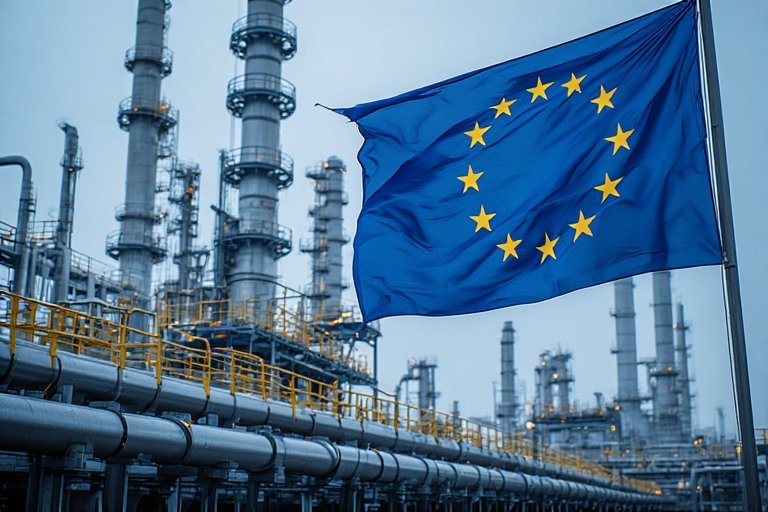
The European Union has formally adopted new legislation aimed at ending imports of Russian gas, completing a key step in the bloc’s long-running effort to sever energy ties with Moscow following Russia’s invasion of Ukraine.
The regulation, given final approval by the Council of the European Union, strengthens the EU’s sanctions and energy security framework by closing remaining legal and logistical pathways through which Russian gas has continued to enter the European market. EU officials describe the move as both a geopolitical and economic necessity, designed to reduce dependence on a supplier increasingly viewed as a strategic risk.
Why the EU Passed the Law
The decision is rooted in the energy shock that followed Russia’s full-scale invasion of Ukraine in 2022. For decades, Russian pipeline gas had been a cornerstone of Europe’s energy mix, particularly in Central and Eastern Europe. When supplies were disrupted and prices surged, the EU accelerated efforts to diversify energy sources and reduce exposure to Russian leverage.
While earlier sanctions targeted coal and oil, gas proved more complex due to long-term contracts, infrastructure constraints, and uneven dependence among member states. This new regulation reflects the EU’s conclusion that partial measures were no longer sufficient.
What the New Regulation Changes
The newly adopted law tightens restrictions on Russian gas by clarifying enforcement rules, strengthening monitoring mechanisms, and limiting contractual loopholes that allowed certain imports to continue. It reinforces the EU’s legal authority to restrict Russian energy flows even where commercial agreements pre-dated sanctions.
Crucially, the regulation aligns energy policy more closely with the EU’s broader sanctions regime, signaling that gas imports are no longer treated as an exceptional category.
How It Interacts With Existing EU Law
Rather than repealing a single earlier statute, the regulation builds on and amends the EU’s post-2022 sanctions framework and internal energy market rules. It complements emergency energy measures adopted after the Ukraine invasion and integrates them into a more permanent legal structure.
This approach reflects the EU’s shift from crisis management toward long-term strategic decoupling from Russian fossil fuels.
Impact on EU Citizens and Energy Markets
For consumers, EU officials argue that the immediate impact will be limited, as Russian gas already accounts for a much smaller share of supply than before the war. However, the law reinforces the bloc’s reliance on alternative suppliers, liquefied natural gas (LNG), and accelerated renewable deployment.
Critics warn that long-term energy prices could remain volatile and that poorer households may feel indirect effects if global gas markets tighten. Supporters counter that reducing geopolitical risk ultimately stabilizes prices and strengthens energy security.
Global and Geopolitical Consequences
The regulation further isolates Russia from European energy markets and signals that the EU views energy dependence as a security issue, not just an economic one. It also strengthens the EU’s credibility when urging other countries to reduce reliance on sanctioned energy sources.
At the same time, the move increases Europe’s engagement with alternative suppliers in the Middle East, the United States, and Africa, reshaping global gas trade patterns.
Bottom Line
By formally adopting legislation to end Russian gas imports, the EU has turned a political commitment into binding law. The decision marks a decisive step in Europe’s post-Ukraine energy strategy—one that prioritizes security and geopolitical resilience, even at the cost of long-standing commercial relationships.
Sources:
Council of the European Union (press release); Reuters reporting on EU energy sanctions; European Commission energy policy briefings.